
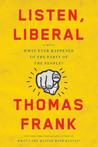
Listen, Liberal: Or, What Ever Happened to the Party of the People
"A blistering autopsy of the Democratic Party's betrayal of its working-class roots for a professional-managerial elite."
- 1The Democratic Party has abandoned its historic commitment to labor. The party's philosophical core shifted from economic populism and union advocacy to a neoliberal consensus prioritizing free markets, deregulation, and corporate-friendly policies, leaving the working class without a political champion.
- 2Professional-class elitism replaced working-class solidarity as the party's engine. Power migrated from labor unions to a credentialed elite of lawyers, bankers, and technocrats. This new base values meritocracy and symbolic cultural victories over broad-based economic justice, deepening societal inequality.
- 3Identity politics often serves as a substitute for material economic policy. While supporting social liberalism, the party's elite uses diversity and inclusion rhetoric to mask a regressive economic agenda, offering cultural recognition to select groups instead of challenging financial power structures.
- 4Neoliberal consensus remains unchallenged by Democratic leadership. Despite electoral victories, Democratic administrations have consistently advanced policies—from financial deregulation to free-trade agreements—that accelerate middle-class decline and enrich Wall Street, cementing a bipartisan economic orthodoxy.
- 5This ideological shift created the conditions for populist backlash. By vacating the field of economic populism, the Democrats allowed right-wing populists to weaponize cultural resentment and capture disaffected working-class voters, a strategic failure decades in the making.
Thomas Frank’s Listen, Liberal is a polemical and meticulously researched indictment of the modern Democratic Party, tracing its dramatic transformation from the party of Franklin D. Roosevelt’s New Deal coalition to the champion of a new professional and managerial elite. Frank argues that this is not merely a shift in tactical focus but a fundamental philosophical realignment, one that has severed the party’s historic ties to the working class and its mission of economic redistribution.
Through a series of case studies—from the Clinton administration’s embrace of financial deregulation and NAFTA to the Obama era’s bailout of Wall Street and pursuit of the Trans-Pacific Partnership—Frank documents how Democratic leaders have actively dismantled the pillars of mid-century liberalism. The book charts the rise of a ‘meritocratic’ class within the party, whose members believe in solving problems through expertise, innovation, and education rather than through collective bargaining or robust social welfare programs.
This new elite, Frank contends, is culturally liberal but economically conservative, more concerned with symbolic victories and diversity initiatives within existing power structures than with challenging the underlying dynamics of wealth and capital. The result is a party that speaks the language of progress while presiding over soaring inequality, stagnant wages, and the continued financialization of the American economy.
Listen, Liberal serves as both a work of recent political history and a urgent manifesto. Its target audience spans disillusioned progressives, students of political economy, and anyone seeking to understand the roots of contemporary political dysfunction. Frank’s core thesis—that the Democrats’ betrayal of economic justice is the central political story of our time—forces a reckoning with the party’s identity and its future viability as an instrument for meaningful change.
The critical consensus views the book as a vital, searing, and fundamentally correct diagnosis of the Democratic Party's failures, though some find its polemical tone overly sarcastic and emotionally charged, which occasionally distracts from the rigor of its arguments. Readers largely agree with Frank's historical analysis, seeing it as a prescient explanation for the rise of right-wing populism and the party's ongoing struggles to connect with working-class voters.
- 1The accuracy and necessity of Frank's searing, sarcastic tone versus its potential to alienate readers and weaken the argument.
- 2The book's prescient analysis of the Democratic Party's abandonment of the working class as a root cause for Trump's 2016 victory.
- 3The critique of identity politics as a deliberate diversion from the party's retreat on economic justice and material conditions.
- 4The examination of the Clinton and Obama administrations as primary architects of the party's neoliberal, pro-Wall Street turn.
The Essays of Warren Buffett: Lessons for Corporate America
Lawrence A. Cunningham, Warren Buffett

Out of Control
Kevin Kelly

The Artist's Way
Julia Cameron
The Road to Financial Freedom
Bodo Schäfer
The Lessons of History
Will Durant

How to Win Friends & Influence People
Dale Carnegie
Radical Markets: Uprooting Capitalism and Democracy for a Just Society
Eric A. Posner, E. Glen Weyl

Transformation in Christ
Dietrich Von Hildebrand

Stumbling on Happiness
Daniel Gilbert

The Creative Habit
Twyla Tharp, Mark Reiter

Amusing Ourselves to Death: Public Discourse in the Age of Show Business
Neil Postman

The Almanack of Naval Ravikant
Naval Ravikant, Eric Jorgenson